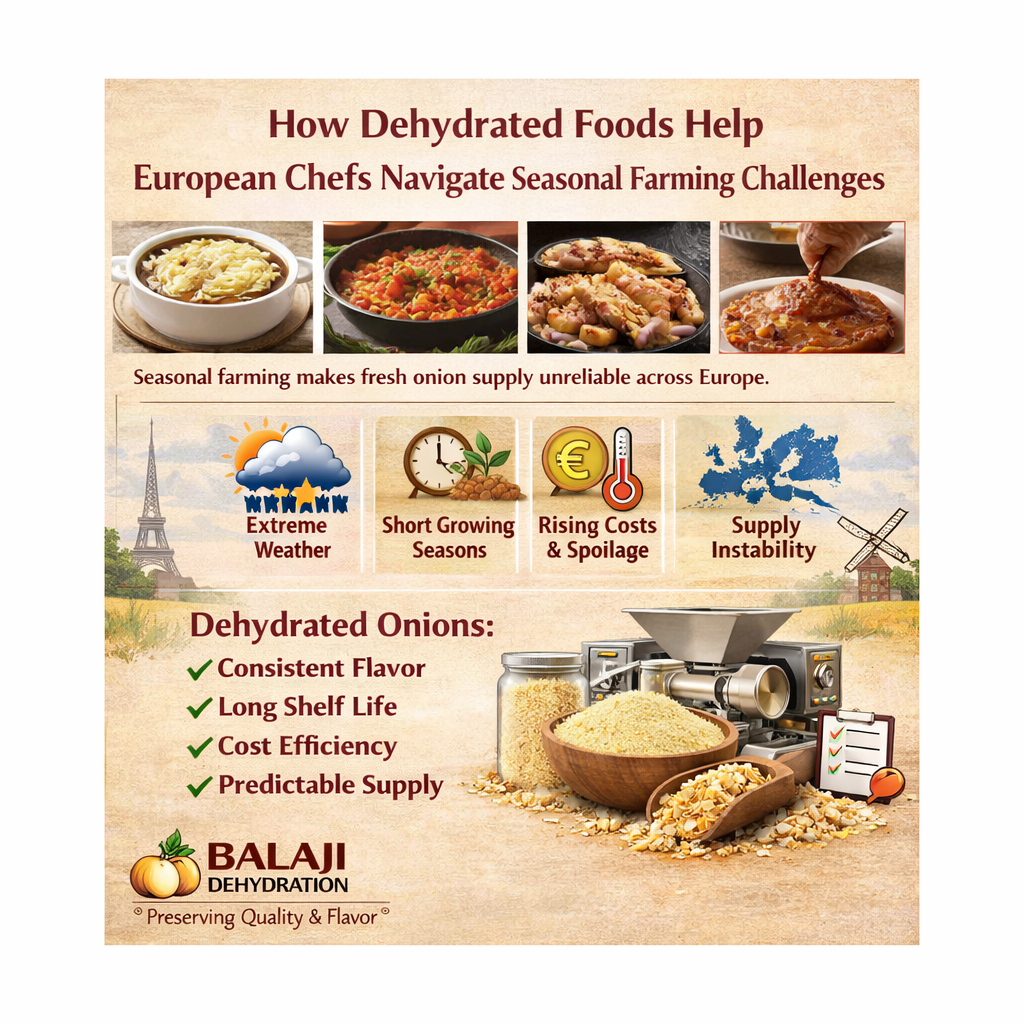
Europe’s food industry depends heavily on onions. From French soups and Spanish sofritos to German sausages and British gravies, onion is not just an ingredient — it is a foundation of flavor. Yet across many European countries, onion supply has become increasingly unpredictable. Short growing seasons, rising energy costs, extreme weather patterns, and storage limitations have created price volatility and availability gaps. For food manufacturers, restaurant chains, and private-label brands, this inconsistency creates real operational risk. The question is no longer just about sourcing onions — it is about securing stability.
Fresh onions are highly sensitive to harvest conditions. A poor season in one region can drive prices up across multiple European markets. Storage requires controlled conditions, and spoilage during transportation is common. Even when supply is available, variations in moisture content, pungency, and size can affect production results. For food processors who require standardized taste profiles, this inconsistency directly impacts product quality. In an industry where consumers expect the same flavor every time, unpredictability is costly.
This is where dehydrated onions offer a strategic advantage for European buyers. By processing onions at peak freshness and removing moisture under controlled conditions, dehydration preserves flavor intensity while extending shelf life significantly. Dehydrated onion flakes, granules, and powders provide consistent pungency, uniform texture, and easy dosage control in industrial production. Whether used in seasoning blends, ready meals, soups, sauces, or snack coatings, dehydrated onions ensure batch-to-batch consistency — something fresh supply chains often struggle to guarantee.
Cost control is another major benefit. Dehydrated onions reduce storage space requirements, eliminate refrigeration dependency, and minimize waste from spoilage. Their long shelf life allows European importers and manufacturers to maintain stable inventory without the pressure of immediate turnover. This creates better procurement planning and protects margins during volatile agricultural seasons. For businesses operating in competitive European markets, predictability in pricing and quality becomes a competitive advantage.
Sustainability also plays a growing role in European purchasing decisions. Dehydrated onions reduce food waste throughout the supply chain. Their lighter weight lowers transportation impact, and efficient packaging reduces material usage compared to bulk fresh shipments. As European companies strive to meet sustainability goals and environmental regulations, dehydrated onion solutions align with both operational efficiency and responsible sourcing strategies.
Balaji Dehydration supports this evolving need by delivering export-ready dehydrated onion products that meet international quality standards. With controlled processing, strict hygiene practices, and reliable logistics, the company helps European partners maintain a steady supply regardless of seasonal disruptions. Instead of reacting to harvest uncertainties, buyers can plan with confidence.
In today’s European food landscape, resilience matters as much as flavor. Dehydrated onions are not simply an alternative to fresh produce — they are a strategic tool for ensuring continuity, consistency, and cost stability. For European manufacturers, retailers, and food service operators, choosing the right onion supply partner may be the difference between seasonal vulnerability and year-round strength.